Tag Archives: arthritis-friendly stretches

Glute Stretches For Seniors: Why They Tighten and How to Release Them

Glute Stretches For Seniors: Why They Tighten and How to Release Them

Last updated: July 15, 2026

Quick Answer

Glute stretches for seniors help release tightness caused by prolonged sitting and reduced activity, which can lead to lower back pain, hip discomfort, and difficulty with daily movements like standing from chairs or walking. Regular stretching of the gluteal muscles improves mobility, reduces pain, and maintains independence in everyday tasks.

Key Takeaways

  • Tight glutes are common after age 50 due to extended sitting, reduced activity, and natural muscle changes
  • Tight gluteal muscles contribute directly to lower back pain, hip stiffness, and walking difficulties
  • Effective glute stretches for seniors include figure-4 stretch, seated glute stretch, and supine knee-to-chest variations
  • Seniors can perform most glute stretches while seated in a chair, making them accessible for those with limited mobility
  • Stretching glutes 3-5 times per week for 20-30 seconds per stretch produces noticeable improvement within 2-4 weeks
  • Static stretches work best for seniors, held gently without bouncing or forcing the movement
  • Those with arthritis should use modified positions and avoid deep hip flexion that causes pain
  • Glute stretches that require lying on the floor can be adapted to bed or chair positions
Key Takeaways

Why Do Glutes Get Tight as You Age

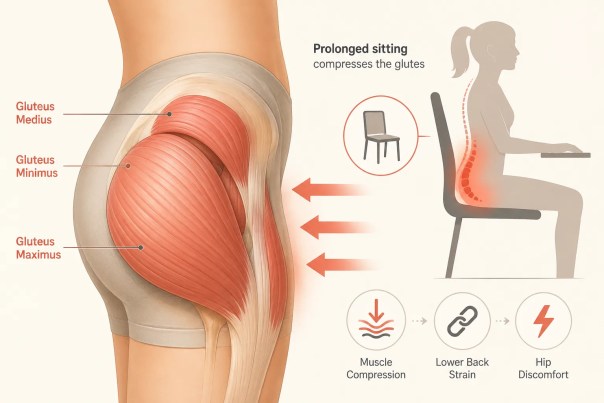
The gluteal muscles tighten with age primarily because of prolonged sitting and decreased daily activity, which cause the muscle fibers to shorten and lose flexibility. When you sit for extended periods, the glutes remain in a compressed, shortened position for hours at a time, and over months and years, they adapt to this position as their new normal length.

Beyond sitting, several age-related factors contribute to glute tightness:

  • Reduced overall movement: Walking less, climbing fewer stairs, and avoiding activities that require hip extension all allow the glutes to weaken and tighten
  • Muscle fiber changes: After age 50, muscle tissue naturally loses some elasticity and becomes stiffer if not regularly stretched
  • Compensation patterns: When other muscles weaken (like the core or hip flexors), the glutes often tighten to compensate for instability
  • Inflammation: Low-grade inflammation in joints and connective tissue becomes more common with age, contributing to stiffness

The glutes consist of three muscles (gluteus maximus, medius, and minimus) that work together to extend the hip, stabilize the pelvis, and support upright posture. When these muscles tighten, they pull on the pelvis and lower spine, creating a chain reaction of discomfort throughout the lower body.

Can Tight Glutes Cause Back Pain in Older Adults

Yes, tight glutes directly cause lower back pain in older adults by altering pelvic alignment and forcing the lower back muscles to work harder during everyday movements. When the gluteal muscles are tight and weak, they cannot properly stabilize the pelvis, so the lumbar spine compensates by taking on extra load during activities like standing, walking, or bending.

The connection works like this: tight glutes pull the pelvis into a posterior tilt (tucking under), which flattens the natural curve of the lower back. This position strains the lumbar discs, facet joints, and surrounding muscles. Additionally, when glutes don’t fire properly during hip extension, the lower back muscles overwork to complete movements that should primarily use the hips.

Research shows that addressing glute tightness and weakness often reduces chronic lower back pain without other interventions. Many seniors who stretch their glutes regularly report significant decreases in daily back discomfort within a few weeks.

Can Glute Stretches Help With Hip Pain

Glute stretches effectively reduce hip pain in seniors by releasing tension in muscles that directly attach to or cross the hip joint. The gluteus medius and minimus, in particular, attach to the outer hip and can cause pain that feels like it’s coming from the hip joint itself when they’re tight or contain trigger points.

Hip pain from tight glutes typically presents as:

  • Deep aching in the outer hip or buttock
  • Pain when lying on the affected side
  • Discomfort when standing from a seated position
  • Stiffness when walking after sitting
  • Limited range of motion when lifting the leg to the side

Stretching releases this tension and restores normal muscle length, which reduces the pulling force on the hip structures. For many seniors, what feels like hip arthritis pain is actually muscular tightness that responds well to consistent stretching. However, if hip pain persists despite regular stretching, or if it’s accompanied by grinding, clicking, or severe limitation, evaluation by a healthcare provider is necessary to rule out joint problems.

For additional ways to maintain hip and leg function, see our guide to leg strengthening exercises for seniors.

Best Glute Stretches For Seniors With Limited Mobility

Seniors with limited mobility can effectively stretch their glutes using chair-based and bed-based positions that don’t require getting down on the floor. These modifications provide the same muscle release as traditional stretches while accommodating balance concerns, joint limitations, or difficulty transitioning to and from the floor.

Seated Figure-4 Stretch

Sit in a sturdy chair with feet flat on the floor. Place your right ankle on your left knee, creating a “4” shape with your legs. Gently press down on your right knee while keeping your back straight. Lean forward slightly from the hips (not the waist) until you feel a stretch in your right glute. Hold for 20-30 seconds, then switch sides.

Modification: If you cannot reach your ankle, place your foot on a low stool instead of your opposite knee.

Seated Knee-to-Chest

While seated, lift your right knee toward your chest and hold it with both hands behind the thigh (not on top of the knee). Pull gently until you feel a stretch in your right glute and lower back. Hold for 20-30 seconds, then switch sides.

Modification: Use a resistance band or towel looped around your thigh if you cannot comfortably reach with your hands.

Supine Glute Stretch (Bed Version)

Lie on your back in bed with knees bent and feet flat. Cross your right ankle over your left knee. Thread your hands through the opening and clasp behind your left thigh. Pull your left thigh toward your chest until you feel a stretch in your right glute. Hold for 20-30 seconds, then switch sides.

This stretch works identically whether performed in bed or on a yoga mat, making it accessible for those who can lie down but struggle with floor transitions.

For more seated exercise options that complement glute stretching, explore our seated chair exercises for seniors.

Supine Glute Stretch (Bed Version)

Glute Stretches Seniors Can Do Sitting Down

Seated glute stretches provide effective muscle release while maintaining stability and safety in a chair. These stretches work well for seniors who spend significant time sitting or who need to stretch during breaks from desk work or television watching.

Seated Piriformis Stretch: Sit with your right ankle crossed over your left knee. Place your right hand on your right knee and gently press it toward the floor while keeping your back straight. You should feel the stretch deep in your right glute. Hold for 20-30 seconds and repeat on the other side.

Seated Spinal Twist with Glute Stretch: Sit sideways in a chair with your right hip against the backrest. Twist your torso to the right and hold the back of the chair with both hands. This position stretches the left glute and lower back. Hold for 20-30 seconds, then switch sides.

Seated Hip Hike: While sitting, lift your right hip up toward your ribs (as if shortening that side of your body), then lower it back down. This movement stretches and activates the glutes alternately. Perform 10-12 repetitions on each side.

These seated variations can be performed multiple times throughout the day without changing clothes or using equipment, making them practical for daily use.

Glute Stretches For Seniors After Sitting All Day

After prolonged sitting, specific glute stretches help reverse the shortened position and restore normal muscle length. These stretches target the compression and tightness that accumulates during extended periods in a chair.

Standing Glute Stretch: Stand facing a counter or sturdy table. Place your right ankle on the surface (knee bent), creating a figure-4 position while standing. Keep your standing leg straight and lean forward from your hips until you feel a stretch in your right glute. Hold for 20-30 seconds, then switch sides.

Doorway Hip Flexor and Glute Stretch: Stand in a doorway with your right foot forward and left foot back in a lunge position. Tuck your pelvis under (posterior tilt) and squeeze your left glute while keeping your left knee straight. This stretches the hip flexor while activating the glute. Hold for 20-30 seconds, then switch sides.

Supine Knee Rocks: Lie on your back with knees bent and feet flat. Let both knees fall to the right side while keeping your shoulders on the floor. Hold for 20-30 seconds, feeling the stretch in your left glute and lower back. Return to center and repeat on the other side.

Perform this sequence after long periods of sitting (such as after meals, long car rides, or work sessions) to prevent the accumulation of tightness. Consistency matters more than duration, three 30-second stretches spread throughout the day work better than one long session.

For a complete approach to staying active throughout the day, see our daily activities for seniors guide.

How Often Should Seniors Stretch Their Glutes

Seniors should stretch their glutes 3-5 times per week for maintenance, or daily if experiencing tightness, pain, or limited mobility. Each stretching session should include 2-3 different glute stretches, held for 20-30 seconds each, and repeated 2-3 times per side.

Frequency guidelines based on goals:

  • Maintenance (no current pain): 3 times per week, 2-3 stretches per session
  • Addressing tightness: 5-6 times per week, 3-4 stretches per session
  • Managing pain: Daily, 4-5 stretches per session, potentially twice per day

The best times to stretch are after light activity when muscles are warm, such as after a walk, after a warm shower, or following gentle exercises for seniors. Avoid aggressive stretching first thing in the morning when muscles are stiffest and cold.

Consistency produces better results than intensity. Gentle, regular stretching gradually lengthens muscle fibers and resets their resting length, while aggressive stretching can cause muscle guarding and actually increase tightness.

How Long Does It Take to Loosen Tight Glutes

Most seniors notice initial improvement in glute tightness within 2-3 weeks of consistent stretching, with significant changes occurring after 4-6 weeks of regular practice. The timeline depends on the severity of tightness, frequency of stretching, and whether you address contributing factors like prolonged sitting.

Typical progression:

  • Week 1-2: Improved awareness of tightness; stretches may feel uncomfortable but should not cause pain
  • Week 3-4: Noticeable increase in range of motion; reduced stiffness when standing from sitting
  • Week 5-8: Measurable improvement in flexibility; decreased back or hip pain; easier movement during daily activities
  • Week 9+: Maintenance phase; continued improvement if stretching continues

Factors that speed up progress include combining stretching with strengthening exercises, reducing sitting time, staying hydrated, and maintaining consistency. Factors that slow progress include inconsistent stretching, continuing to sit for long periods without breaks, and stretching too aggressively (which causes muscle guarding).

If you see no improvement after 4-6 weeks of consistent daily stretching, consult a physical therapist to assess whether other factors (such as joint problems, nerve issues, or compensation patterns) are preventing progress.

How Long Does It Take to Loosen Tight Glutes

Glute Stretches For Seniors With Arthritis

Seniors with arthritis can safely stretch their glutes by using modified positions that avoid deep hip flexion and by working within a comfortable range of motion. Arthritis in the hips, knees, or lower back requires adjustments to standard stretches, but the benefits of maintaining glute flexibility remain important for managing pain and preserving function.

Modified stretches for arthritis:

Gentle Supine Knee-to-Chest: Lie on your back and bring one knee toward your chest only as far as comfortable, using your hands to support behind the thigh (never pulling on the knee joint itself). Hold for 15-20 seconds. This stretch is gentler than the figure-4 variation and puts less stress on the hip joint.

Seated Glute Stretch with Towel: Sit in a chair and place your right foot on a low stool. Loop a towel or resistance band around your right thigh and gently pull it toward you while keeping your back straight. This provides the stretch without requiring deep hip flexion. Hold for 20-30 seconds per side.

Standing Glute Stretch at Counter: Place your right foot on a low step or stool (6-8 inches high) in front of you. Keep your knee slightly bent and lean forward from your hips just until you feel a gentle stretch. This modification reduces the hip flexion angle compared to placing the foot on a higher surface.

Guidelines for arthritis-safe stretching:

  • Warm up the area first with gentle movement or a warm compress
  • Never force a stretch into pain, work at 60-70% of maximum stretch
  • Hold stretches for shorter durations (15-20 seconds) initially
  • Avoid stretches that cause joint pain during or after the stretch
  • Focus on consistency over intensity

If a particular stretch consistently aggravates arthritis symptoms, skip it and focus on the variations that feel manageable. The goal is to maintain available range of motion, not to achieve maximum flexibility.

For additional arthritis-friendly movement options, see our guide to yoga for senior beginners.

Difference Between Static and Dynamic Glute Stretches For Seniors

Static stretches involve holding a position without movement for 20-30 seconds and work best for seniors because they safely lengthen tight muscles without requiring balance or coordination. Dynamic stretches involve controlled movement through a range of motion and are better used as warm-ups before activity rather than for releasing chronic tightness.

Static glute stretches (recommended for most seniors):

  • Figure-4 stretch (seated or supine)
  • Knee-to-chest stretch
  • Piriformis stretch
  • Held for 20-30 seconds, repeated 2-3 times per side
  • Best performed after light activity when muscles are warm
  • Ideal for addressing tightness and improving flexibility

Dynamic glute stretches (use as warm-ups):

  • Leg swings (forward and back, side to side)
  • Walking lunges with a twist
  • Hip circles
  • Performed for 8-12 repetitions per side
  • Best used before walking, exercise, or physical activity
  • Prepare muscles for movement rather than lengthening them

For seniors dealing with tightness, pain, or limited mobility, static stretches should be the primary focus. They’re safer, easier to perform correctly, and more effective for releasing chronic muscle tension. Dynamic stretches can be added once basic flexibility is restored and if you’re preparing for more vigorous activity like balance exercises or walking.

Glute Stretches Seniors Should Avoid

Seniors should avoid glute stretches that require extreme hip flexion, deep squatting, or positions that compromise balance or put excessive stress on the knees and lower back. Some traditional stretches carry unnecessary risk for older adults, especially those with joint issues, balance concerns, or limited flexibility.

Stretches to avoid or modify:

Deep Pigeon Pose: This yoga stretch requires lying face-down with one leg bent underneath the body at an extreme angle. It places significant stress on the knee and hip joint and is difficult to exit safely. Use the seated figure-4 stretch instead, which provides the same muscle release without the joint stress or floor transition.

Standing Figure-4 (unsupported): Balancing on one leg while pulling the other knee toward the chest creates a high fall risk. Always perform this stretch while holding a counter, wall, or sturdy chair for support, or use the seated version instead.

Hurdler Stretch: Sitting on the floor with one leg extended and the other bent back behind the body (like a hurdler position) puts extreme stress on the bent knee and is difficult to get into and out of safely. This stretch offers no advantages over safer alternatives.

Aggressive Bouncing Stretches: Any stretch that involves bouncing or pulsing movements can trigger the muscle’s protective reflex, causing it to tighten rather than lengthen. This approach also increases injury risk. Always stretch smoothly and hold positions steadily.

Warning signs a stretch is inappropriate:

  • Sharp pain in the joint (different from muscle stretch sensation)
  • Inability to breathe normally while holding the position
  • Tingling, numbness, or radiating pain
  • Feeling unstable or at risk of falling
  • Inability to exit the position easily

When in doubt, choose the simplest, most supported version of a stretch. Seated and supine positions are almost always safer than standing or floor-based stretches for seniors.

Glute Stretches That Don’t Require Getting on the Floor

Seniors who cannot get down on the floor or who have difficulty transitioning from floor to standing can effectively stretch their glutes using bed-based and chair-based positions. These alternatives provide equivalent muscle release without the physical challenge of floor transitions.

Bed-based stretches:

Supine Figure-4 on Bed: Lie on your back in bed with knees bent. Cross your right ankle over your left knee and thread your hands through to clasp behind your left thigh. Pull your left thigh toward your chest. This works identically to the floor version but eliminates the need to get up from the floor.

Side-lying Glute Stretch: Lie on your left side in bed with knees bent. Pull your right knee toward your chest while keeping your left leg stationary. This stretches the right glute and is particularly comfortable for those with back issues.

Chair-based stretches:

Seated Figure-4: Described earlier, this is the most versatile no-floor glute stretch. Can be performed in any sturdy chair throughout the day.

Standing Counter Stretch: Stand facing a counter and place your right foot on the counter surface (or on a chair seat if the counter is too high). Lean forward from your hips until you feel a stretch in your right glute. This stretch is accessible for those who can stand but cannot get on the floor.

Bed Edge Stretch: Sit on the edge of your bed with your right ankle crossed over your left knee. Lean forward from your hips while keeping your back straight. The softer surface of the bed makes this more comfortable than a hard chair for some people.

These modifications ensure that mobility limitations don’t prevent you from maintaining glute flexibility. Choose the positions that feel most stable and comfortable for your body.

For more ways to stay active without floor work, explore our standing exercises for seniors.

Do Seniors Need Different Stretches Than Younger People

Seniors need the same basic glute stretches as younger people but should use modified positions that accommodate reduced flexibility, balance concerns, and joint sensitivity. The muscle anatomy and stretching principles remain the same across age groups, but the execution and precautions differ.

Key differences for seniors:

  • Position modifications: Prefer seated and supine positions over standing or deep floor positions
  • Reduced intensity: Work at 60-80% of maximum stretch rather than pushing to the limit
  • Longer warm-up: Spend more time warming muscles before stretching (light movement or warmth)
  • More support: Use chairs, walls, counters, or props for stability during stretches
  • Shorter hold times initially: Start with 15-20 seconds if new to stretching, gradually working up to 30 seconds
  • Greater focus on consistency: Regular, gentle stretching produces better results than occasional aggressive stretching

The stretches themselves, figure-4, knee-to-chest, piriformis stretch, work for all ages. What changes is how you perform them. A 30-year-old might do a figure-4 stretch on the floor without support, while a 70-year-old does the same stretch seated in a chair. Both achieve the same muscle release; the older version simply includes more practical support and safety measures.

Seniors should also pay more attention to how stretches feel during and after. Joint pain (as opposed to muscle stretch sensation) is a signal to modify the position, not push through it. This awareness becomes more important with age as joint changes become more common.

Conclusion

Glute stretches for seniors address a common source of discomfort and limited mobility that develops from prolonged sitting and reduced activity. Tight gluteal muscles contribute to lower back pain, hip stiffness, and difficulty with everyday movements like standing from chairs and walking. Regular stretching, performed 3-5 times per week using seated, standing, or bed-based positions, can produce noticeable improvement within 2-4 weeks.

The most effective approach combines several stretches (figure-4, knee-to-chest, and seated variations) held for 20-30 seconds each, performed when muscles are warm. Seniors with arthritis, balance concerns, or limited mobility should focus on modified positions that provide support and avoid deep joint flexion. Static stretches work better than dynamic movements for releasing chronic tightness.

Next steps:

  1. Choose 2-3 glute stretches from this guide that match your current mobility level
  2. Perform them 3 times this week after light activity or a warm shower
  3. Hold each stretch for 20-30 seconds without forcing or bouncing
  4. Notice how your back, hips, and movement feel after two weeks of consistent practice
  5. Add more stretches or increase frequency if you want faster progress

Consistency matters more than intensity. Even five minutes of gentle stretching several times per week can restore comfort and function to tight glutes, making daily activities easier and more comfortable. For a complete approach to staying mobile and active, combine glute stretching with the simple mobility exercises and healthy habits that support long-term function.


References

[2] Glute Exercises For Seniors The Best Moves To Try And Why Theyre So Good For You – https://www.agebold.com/resources/glute-exercises-for-seniors-the-best-moves-to-try-and-why-theyre-so-good-for-you

[5] At Home Exercises Stretches For Your Glutes – https://shelteringarmsinstitute.com/rehablogs/at-home-exercises-stretches-for-your-glutes/

[7] Stretches For Tight Glutes – https://www.goodrx.com/well-being/movement-exercise/stretches-for-tight-glutes


This article is part of our Stretching & Flexibility Exercises for Seniors series.

Share This Page

Leg Stretching Exercises For Seniors: A Complete Lower Body Routine

Professional () hero image with (โ‰ค42 chars): 'Leg Stretching Exercises For Seniors', white on a semi-transparent dark panel,

Last updated: July 15, 2026

Quick Answer

Leg stretching exercises for seniors should target all major lower body muscle groups, hamstrings, quadriceps, calves, hip flexors, and IT band, through gentle, sustained stretches held for 15-30 seconds each. A complete routine takes 10-15 minutes and can be done daily or at least three times per week to maintain flexibility, reduce fall risk, and support everyday movement like walking, climbing stairs, and getting in and out of chairs.

Key Takeaways

  • Hold each stretch for 15-30 seconds without bouncing to allow muscles to lengthen safely
  • Stretch at least three times per week, though daily stretching provides the best results for maintaining flexibility
  • Both seated and standing options accommodate different mobility levels and balance confidence
  • Warm muscles stretch more safely,do light movement like marching in place for 3-5 minutes before stretching
  • Mild tension is normal; sharp pain is not,back off immediately if a stretch causes discomfort beyond gentle pulling
  • Consistent stretching helps prevent falls by maintaining the range of motion needed for balance recovery
  • People with arthritis benefit from gentle stretching when done within comfortable limits
  • Tight hamstrings respond well to regular stretching,most people see improvement within 2-4 weeks of daily practice
Key Takeaways

What Are the Best Leg Stretches for Seniors

The best leg stretches for seniors address the five major lower body muscle groups that affect daily function: hamstrings (back of thigh), quadriceps (front of thigh), calves (back of lower leg), hip flexors (front of hip), and the IT band (outer thigh). These muscles work together during walking, stair climbing, and standing from seated positions.

Essential stretches for a complete routine:

  • Seated hamstring stretch, Sit in a chair, extend one leg forward with heel on floor, keep back straight, lean forward from hips until you feel gentle pulling behind the thigh
  • Standing quad stretch, Hold a chair or wall for balance, bend one knee to bring heel toward buttocks, gently pull foot closer with hand
  • Calf stretch, Stand facing a wall with hands on wall for support, step one foot back keeping heel down, lean forward until you feel pulling in back of lower leg
  • Hip flexor stretch, Stand in a staggered stance with one foot forward, gently shift weight forward while keeping back heel down until you feel pulling at front of back hip
  • IT band stretch, Stand and cross one leg behind the other, lean toward the side of the front leg until you feel pulling along outer thigh

These five stretches form the foundation of a complete lower body routine. Each one can be modified to match your current flexibility and balance confidence.

How Long Should Seniors Hold Leg Stretches

Seniors should hold each leg stretch for 15-30 seconds to allow muscles to lengthen without triggering a protective tightening response. Research shows that holding stretches for less than 15 seconds provides minimal benefit, while holds beyond 30 seconds don’t significantly improve results for most people [1].

Practical hold-time guidelines:

  • Beginners or very tight muscles: Start with 15-second holds
  • Moderate flexibility: Use 20-25 second holds
  • Maintaining current flexibility: 30-second holds work well
  • Repeat each stretch 2-3 times per leg for best results

The stretch should feel like gentle pulling or mild tension, not pain. If you can’t hold a position for 15 seconds comfortably, you’re stretching too deeply. Back off until you find a position you can sustain with steady breathing.

Avoid bouncing or pulsing during stretches. This “ballistic stretching” can trigger muscle reflexes that cause tightening rather than lengthening, and it increases injury risk [1].

Leg Stretches for Seniors With Arthritis

Seniors with arthritis can safely perform leg stretches by working within a comfortable range of motion and avoiding positions that compress inflamed joints. Gentle stretching helps maintain the mobility needed for daily activities and can reduce stiffness when done regularly [2].

Arthritis-friendly modifications:

  • Reduce the depth of each stretch,stop at the first sign of pulling rather than pushing to maximum range
  • Warm up longer,5-10 minutes of gentle movement helps reduce joint stiffness before stretching
  • Use seated versions when standing stretches put too much pressure on knees or hips
  • Stretch after warm showers or baths when joints feel less stiff
  • Skip stretches on days when joints are particularly swollen or painful

For arthritic knees, the seated hamstring stretch works better than standing versions because it doesn’t require full weight-bearing. For hip arthritis, keep the hip flexor stretch shallow and use a chair for support.

If any stretch causes sharp pain or increased swelling after you finish, that stretch is too aggressive for your current condition. Mark it and try again in a few weeks after building tolerance with gentler movements. Consider reviewing your routine with a physical therapist who can suggest specific modifications for your arthritis pattern.

Can Seniors Do Deep Leg Stretches Safely

Seniors can do deeper leg stretches safely if they have good balance, no significant joint problems, and have built up flexibility gradually over time. “Deep” doesn’t mean forcing a stretch, it means working near your personal end range of motion while maintaining control and steady breathing.

Safety factors for deeper stretches:

  • Balance confidence matters,deep standing stretches require more stability; use wall or chair support
  • Progress gradually,increase depth by small amounts over weeks, not within a single session
  • Never stretch cold muscles,deeper stretches require thorough warm-up (5-10 minutes of movement)
  • Watch for compensation patterns,if you have to twist your body, hold your breath, or grip tightly to maintain a position, the stretch is too deep

The goal isn’t maximum flexibility. The goal is maintaining enough range of motion to walk, climb stairs, get dressed, and recover balance when you stumble. Most daily activities require moderate flexibility, not extreme ranges.

A common mistake is comparing your current flexibility to what you could do decades ago. Your safe range today is what matters. Deep stretches that felt fine at 30 may stress joints and connective tissues differently at 70.

How Often Should Seniors Stretch Their Legs

Seniors should stretch their legs at least three times per week to maintain current flexibility, though daily stretching provides better results for improving range of motion and reducing stiffness [5]. The American Heart Association recommends flexibility training at least 2-3 days per week for older adults [5].

Frequency guidelines by goal:

  • Maintaining current flexibility: 3 times per week minimum
  • Improving flexibility or reducing tightness: 5-7 times per week (daily)
  • Managing chronic stiffness: Daily stretching, ideally at the same time each day
  • After strength training: Light stretching on workout days helps reduce next-day soreness

You can stretch the same muscle groups daily without harm as long as you’re not forcing positions or stretching through pain. Unlike strength training, which requires recovery days, gentle stretching can be done every day.

Many people find that splitting their routine helps with consistency: a few stretches in the morning to reduce overnight stiffness, and a few in the evening to relax before bed. This approach works better than trying to fit a full 15-minute session into a busy schedule.

For more context on building a complete movement routine, see our guide to stretching for seniors.

Leg Stretches for Seniors to Improve Flexibility

To improve leg flexibility rather than just maintain it, seniors need consistent daily stretching with gradual progression over 4-8 weeks. Flexibility gains come from regular practice, occasional stretching maintains what you have but rarely creates improvement.

Progression strategy for flexibility gains:

  1. Weeks 1-2: Establish baseline, stretch to comfortable tension, hold 15-20 seconds, focus on consistency
  2. Weeks 3-4: Increase hold time to 25-30 seconds, add a third repetition of each stretch
  3. Weeks 5-6: Gently increase depth by leaning slightly further into each stretch once muscles feel warm
  4. Weeks 7-8: Maintain new range with 30-second holds, 2-3 repetitions per side

Flexibility improves slowly. Expecting quick results leads to overstretching, which can cause small tears in muscle fibers and actually reduce flexibility temporarily while they heal.

Realistic expectations:

  • Most people notice easier movement within 2 weeks of daily stretching
  • Measurable range-of-motion gains typically appear after 4 weeks
  • Significant improvements in very tight muscles may take 8-12 weeks

The hamstrings, hip flexors, and calves tend to respond well to consistent stretching. The IT band is more resistant to change and may require longer practice periods.

Pair leg stretching with leg strengthening exercises for the best functional results, flexible muscles that lack strength don’t support daily activities effectively.

Easy Leg Stretches for Seniors With Limited Mobility

Easy Leg Stretches for Seniors With Limited Mobility

Seniors with limited mobility can perform effective leg stretches entirely from a seated position, using a chair for support and stability. These modifications provide the same muscle-lengthening benefits without requiring balance, floor work, or standing.

Seated stretch modifications:

Seated hamstring stretch: Sit near the front edge of a sturdy chair, extend one leg forward with heel on floor and toes pointing up, keep the other foot flat on floor, place hands on thighs, lean forward from hips (not by rounding your back) until you feel gentle pulling behind the extended thigh.

Seated quad stretch: Sit sideways on a chair, extend one leg behind you with knee bent and top of foot resting on floor, keep the other foot flat on floor in front, gently press hips forward until you feel pulling at front of the extended thigh. (If this is too difficult, simply bend one knee and use your hand to gently pull that foot toward your buttocks while seated.)

Seated calf stretch: Sit with one leg extended, loop a towel or belt around the ball of your foot, gently pull the towel toward you while keeping your knee straight until you feel pulling in your calf.

Seated hip flexor stretch: Sit near the front edge of a chair, slide one foot back so that leg extends behind you with knee bent, keep the other foot flat on floor, sit up tall and gently press hips forward.

These seated versions work well for people using wheelchairs, those with significant balance issues, or anyone recovering from illness or surgery. They’re also useful on days when you feel unsteady but still want to maintain your stretching routine.

For additional seated movement options, see our seated chair exercises guide.

Leg Stretches for Seniors to Prevent Falls

Regular leg stretching helps prevent falls by maintaining the ankle, knee, and hip range of motion needed to recover balance when you stumble. Tight leg muscles limit how far you can step to catch yourself, making falls more likely when you encounter uneven surfaces or trip hazards [2].

Fall-prevention priorities:

  • Calf and ankle flexibility allow you to lift your toes higher when walking, reducing trip risk over thresholds and uneven pavement
  • Hip flexor flexibility enables longer, more confident steps and better ability to step forward quickly to catch your balance
  • Hamstring flexibility makes it easier to navigate stairs and step up onto curbs without losing balance

The standing calf stretch and hip flexor stretch are particularly valuable for fall prevention because they target the exact movements you need during balance recovery. Practice these stretches while holding a sturdy counter or chair, this setup mimics real-world situations where you’ll grab something for support.

Stretching alone doesn’t prevent falls. It works best when combined with balance exercises that train your body to react quickly when stability is challenged. Together, flexibility and balance training create a stronger defense against falls than either approach alone.

Seated Leg Stretches for Seniors

Seated leg stretches provide a safe, accessible way to maintain lower body flexibility without balance demands. These stretches work well as a standalone routine or as a warm-up before standing exercises.

Complete seated leg routine (10 minutes):

  1. Seated hamstring stretch, 20 seconds each leg, repeat twice
  2. Seated calf stretch with towel, 20 seconds each leg, repeat twice
  3. Ankle circles, 10 circles each direction, both ankles (improves ankle mobility)
  4. Seated hip flexor stretch, 20 seconds each side, repeat twice
  5. Knee extensions, Sit tall, straighten one knee to lift foot off floor, hold 5 seconds, lower; repeat 10 times each leg (combines stretching with gentle strengthening)

This routine addresses all major leg muscle groups while keeping you stable and supported. It works particularly well first thing in the morning when overnight stiffness makes standing stretches uncomfortable.

Chair selection matters. Use a sturdy chair without wheels, with a seat height that lets your feet rest flat on the floor when sitting back. Avoid soft cushions that make it hard to maintain upright posture during stretches.

Standing Leg Stretches for Seniors Balance

Standing leg stretches challenge balance while improving flexibility, making them valuable for seniors who want to maintain or improve stability. Always perform standing stretches near a wall, counter, or sturdy chair you can grab if needed.

Standing stretch routine with balance benefits:

Standing quad stretch: Stand next to a wall or chair, place one hand on the support, bend one knee to bring heel toward buttocks, hold foot with free hand, keep knees close together, hold 20 seconds. (This stretch requires single-leg balance, which trains the stabilizer muscles in your standing leg.)

Standing calf stretch: Face a wall with hands on wall for support, step one foot back 2-3 feet, keep back heel down and leg straight, bend front knee until you feel pulling in back calf, hold 20 seconds.

Standing hamstring stretch: Stand facing a chair or low step, place one heel on the chair seat with leg straight, keep standing leg slightly bent, lean forward from hips until you feel pulling behind elevated thigh, hold 20 seconds.

Standing hip flexor stretch: Stand in a staggered stance near a wall for support if needed, place one foot 2-3 feet behind the other, keep both feet pointing forward, gently shift weight forward while keeping back heel down, hold 20 seconds.

As your balance improves, gradually reduce how much you rely on your support. Start by using one finger on the wall instead of your whole hand. Eventually you may be able to perform some stretches without touching support at all, though keeping it nearby remains smart.

What Happens If Seniors Don’t Stretch

Seniors who don’t stretch typically experience gradual loss of flexibility over months and years, leading to shorter stride length, difficulty with stairs, trouble bending to tie shoes, and increased fall risk. The changes happen slowly enough that many people don’t notice until specific movements become difficult or impossible [2].

Common consequences of not stretching:

  • Reduced walking speed and stride length,tight hip flexors and hamstrings limit how far forward you can swing your leg
  • Difficulty with stairs,tight calves and hamstrings make it harder to lift your foot high enough for each step
  • Trouble reaching feet,tight hamstrings prevent the forward bending needed to put on shoes or trim toenails
  • Increased fall risk,limited ankle flexibility makes it easier to trip; tight hips reduce your ability to step quickly to catch balance
  • Chronic muscle tension and discomfort,tight muscles pull on joints and create persistent aching

Flexibility loss isn’t inevitable with aging. Much of what we attribute to “getting old” actually results from reduced activity and lack of stretching. Studies show that older adults who stretch regularly maintain flexibility levels much closer to younger adults than those who don’t stretch [1].

The good news: flexibility can be regained. Even if you haven’t stretched in years, starting a regular routine typically produces noticeable improvements within 4-6 weeks. You may not return to the flexibility you had at 20, but you can recover enough range of motion to make daily activities easier and more comfortable.

Leg Stretches for Seniors With Tight Hamstrings

Leg Stretches for Seniors With Tight Hamstrings

Tight hamstrings respond well to daily stretching that gradually increases range of motion over several weeks. The seated hamstring stretch works better than standing versions for very tight hamstrings because it’s easier to control the intensity and maintain proper form.

Progressive hamstring routine:

Week 1-2: Seated hamstring stretch, 15-second holds, 2 repetitions per leg, once daily. Focus on keeping your back straight rather than rounding forward, the stretch should come from hinging at your hips, not curling your spine.

Week 3-4: Increase to 20-second holds, 3 repetitions per leg, once daily. You should notice you can lean slightly further forward while maintaining straight back posture.

Week 5-6: Increase to 25-30 second holds, 3 repetitions per leg, once daily. By now, reaching your toes (or closer to them) should feel easier.

Maintenance: Continue 30-second holds, 2-3 repetitions per leg, at least 3 times per week to maintain gains.

Common hamstring stretching mistakes:

  • Rounding your back to reach further (this stretches your spine, not your hamstrings)
  • Holding your breath during the stretch (breathe normally throughout)
  • Bouncing to try to reach further (this can cause small muscle tears)
  • Comparing your flexibility to others (your safe range is individual)

If one hamstring is significantly tighter than the other, spend extra time on the tighter side. Muscle imbalances can affect walking patterns and contribute to hip or knee discomfort.

Tight hamstrings often develop alongside weak glutes (buttock muscles). Consider adding leg strengthening work to address both sides of the equation.

Are Leg Stretches Good for Seniors With Knee Pain

Leg stretches can help seniors with knee pain by reducing tension in muscles that attach near the knee joint, particularly the quadriceps, hamstrings, and calves. Tight muscles create pulling forces on the knee that can worsen pain, while appropriate stretching often provides relief [2].

Knee-friendly stretching guidelines:

  • Avoid deep knee bending during stretches, keep stretches in ranges that don’t compress the knee joint
  • Focus on muscles above and below the knee,tight quads, hamstrings, and calves all affect knee mechanics
  • Use seated versions when standing stretches aggravate knee pain
  • Stretch after gentle warm-up when joints feel less stiff
  • Stop any stretch that increases knee pain either during or after the session

The seated hamstring stretch and standing calf stretch typically work well for people with knee pain because they don’t require significant knee bending. The quad stretch may need modification, if pulling your foot toward your buttocks hurts your knee, try a gentler version where you only bend your knee partway.

When to avoid stretching:

  • During acute knee injury or immediately after knee surgery (follow your surgeon’s timeline)
  • When knee is hot, red, or significantly swollen
  • If stretching consistently makes pain worse over several sessions

Knee pain has many causes, arthritis, old injuries, muscle imbalances, or alignment issues. If stretching doesn’t help after 2-3 weeks of consistent practice, or if pain is getting worse, see a healthcare provider. You may need targeted treatment or exercises beyond general stretching.

How to Know If You’re Stretching Too Hard as a Senior

You’re stretching too hard if you feel sharp pain, can’t breathe normally, have to grip tightly to hold position, or experience increased soreness that lasts more than a few hours after stretching. Proper stretching creates gentle pulling or mild tension, not pain [1].

Signs you’re overdoing it:

  • Sharp, stabbing, or burning sensations during the stretch (stop immediately)
  • Muscle soreness that lasts more than 24 hours after stretching
  • Bruising or swelling after a stretching session
  • Shaking or trembling while holding a stretch (sign you’re past your comfortable range)
  • Holding your breath because the position is uncomfortable
  • Reduced flexibility the day after stretching (indicates you caused small muscle tears)

Proper stretch intensity feels like:

  • Gentle pulling or mild tension in the muscle
  • Sensation you could hold comfortably for 30 seconds
  • Feeling that lessens slightly as you hold the position
  • Ability to breathe normally throughout

The “no pain, no gain” mentality doesn’t apply to stretching, especially for older adults. Forcing stretches beyond comfortable limits causes microtrauma to muscle fibers and connective tissue, which triggers inflammation and protective tightening, the opposite of what you want.

If you consistently overstretch, your muscles will become more resistant to lengthening as a protective response. This makes you less flexible over time, not more. Gentle, consistent stretching produces better results than aggressive, sporadic sessions.

For additional guidance on safe movement practices, see our gentle exercises guide.

Complete Lower Body Stretching Routine for Seniors

This complete routine addresses all major leg muscle groups in a logical sequence that takes 12-15 minutes. Perform this routine at least three times per week, or daily for best results.

Warm-up (3-5 minutes):

  • March in place or walk around your home
  • Do 10-15 ankle circles in each direction
  • Gently swing each leg forward and back 10 times

Main stretching sequence:

  1. Seated hamstring stretch, 20 seconds each leg, 2 repetitions
  2. Seated or standing quad stretch, 20 seconds each leg, 2 repetitions
  3. Standing calf stretch, 20 seconds each leg, 2 repetitions
  4. Standing hip flexor stretch, 20 seconds each side, 2 repetitions
  5. IT band stretch, 20 seconds each side, 2 repetitions

Cool-down:

  • Walk slowly for 1-2 minutes
  • Take a few deep breaths

Routine notes:

  • Rest 5-10 seconds between repetitions
  • Use support (chair, wall, counter) for all standing stretches
  • Modify to seated versions on days when balance feels uncertain
  • Track your routine in a simple notebook to maintain consistency

This routine pairs well with back stretching exercises for complete upper and lower body flexibility. Consider alternating focus, legs one day, back the next, or doing both if you have 25-30 minutes available.

Conclusion

Leg stretching exercises for seniors maintain the lower body flexibility needed for walking, climbing stairs, and recovering balance when you stumble. A complete routine targeting hamstrings, quadriceps, calves, hip flexors, and IT band takes 12-15 minutes and works best when done at least three times per week, though daily practice produces better results.

Start with seated versions if balance is a concern, hold each stretch for 15-30 seconds without bouncing, and work at an intensity that creates gentle pulling rather than pain. Most people notice easier movement within two weeks and measurable flexibility gains after four weeks of consistent practice.

The routine outlined here provides practical guidance for maintaining the range of motion that supports everyday function. Pair it with regular strength work and balance training for the most complete approach to lower body health.

Begin with the warm-up, work through the five main stretches, and track your sessions to build consistency. Adjust depth and position based on how your body feels each day, and remember that flexibility improves gradually, gentle, regular practice beats aggressive, sporadic sessions every time.

References

[1] Art 20546848 – https://www.mayoclinic.org/healthy-lifestyle/fitness/in-depth/stretching/art-20546848

[2] Stretching Exercises – https://www.healthline.com/health/senior-health/stretching-exercises

[5] How Much And How Often Should People Stretch – https://www.heart.org/en/news/2024/08/07/how-much-and-how-often-should-people-stretch


This article is part of our Stretching & Flexibility Exercises for Seniors series.

Share This Page

Groin Stretches For Seniors: Improving Hip Mobility and Daily Movement

Professional () hero image with 'Groin Stretches For Seniors' (โ‰ค42 chars) in crisp white on a semi-transparent dark panel,

Last updated: July 15, 2026

Quick Answer: Groin stretches for seniors target the inner thigh muscles (adductors) that tighten with age and affect walking, balance, and hip function. Regular stretching of this area, through seated, standing, or supported variations, can improve stride length, reduce stiffness, and make daily movements like getting in and out of a car easier and more comfortable.

Key Takeaways

  • The groin and inner thigh muscles tighten naturally with age due to reduced activity, prolonged sitting, and loss of muscle elasticity
  • Tight groin muscles shorten stride length, limit hip rotation, and increase fall risk during lateral movements
  • Seated butterfly stretches, standing adductor stretches, and side lunges are the three most practical groin stretches for older adults
  • Stretching the groin 3-5 times per week for 20-30 seconds per position can improve flexibility within 4-6 weeks
  • Chair-supported and wall-supported modifications make groin stretches accessible for those with balance concerns or arthritis
  • Groin stretches differ from hip flexor stretches: groin stretches target inner thigh muscles, while hip flexor stretches address the front of the hip
  • Avoid forcing deep stretches or bouncing movements, which can strain muscles and connective tissue
Key Takeaways

What Are Groin Stretches and Why Do Seniors Need Them

Groin stretches target the adductor muscles, a group of five muscles running along the inner thigh from the pelvis to the inner knee. These muscles pull the legs together and stabilize the pelvis during walking, turning, and standing. As adults age past 50, these muscles lose elasticity and shorten from reduced range-of-motion activities and extended sitting [1].

Tight groin muscles affect everyday function in specific ways:

  • Gait changes: Shortened adductors limit how far the leg can swing outward during each step, creating a narrower, shuffling walk pattern
  • Hip rotation: Restricted inner thigh flexibility reduces the hip’s ability to rotate inward and outward, making movements like pivoting or stepping over objects harder
  • Getting in and out of cars: The wide leg position needed to enter a vehicle requires groin flexibility; tightness makes this movement awkward and uncomfortable
  • Balance during lateral movements: Stepping sideways or catching yourself from a stumble requires the groin muscles to lengthen quickly; stiff muscles respond more slowly

The hip adductor stretch specifically lengthens these inner thigh muscles, improving hip mobility essential for walking, bending, and balance activities [4]. Regular stretching helps maintain the muscle length needed for normal stride patterns and reduces the compensation movements that can lead to hip or knee pain.

For a broader look at flexibility work, see our guide to stretching for seniors.

Best Groin Stretches for Seniors With Limited Mobility

Three groin stretches work well for older adults with movement restrictions: the seated butterfly, the standing wall-supported adductor stretch, and the chair-assisted side reach.

Seated Butterfly Stretch

Sit in a sturdy chair with feet flat on the floor. Slide both feet together until the inner edges of your shoes touch. Let your knees fall gently outward as far as comfortable. Place your hands on your inner thighs and apply light downward pressure. Hold for 20-30 seconds. This version requires no floor work and keeps the back supported [3].

Standing Wall-Supported Adductor Stretch

Stand facing a wall, placing both hands flat against it at shoulder height. Step your feet wider than shoulder-width apart. Keep both feet pointing forward. Bend your right knee while keeping your left leg straight, shifting your weight to the right. You should feel a stretch along the inner left thigh. Hold for 20-30 seconds, then switch sides. The wall provides balance support throughout the movement [5].

Chair-Assisted Side Reach

Stand beside a sturdy chair, holding the backrest with your right hand. Step your left foot out to the side, about two feet from your right foot. Keep both feet flat and pointing forward. Gently lean your torso to the right, feeling a stretch along the inner left thigh and side. Hold for 20-30 seconds, then switch sides. This stretch combines groin lengthening with lateral trunk movement [1].

Modification tips for very limited mobility:

  • Perform all stretches after warming up with 5 minutes of gentle movement
  • Reduce the range of motion by half and gradually increase over several weeks
  • Use a folded towel under the feet during seated stretches to reduce the required hip angle
  • Hold onto two chairs (one on each side) during standing stretches for extra stability

These exercises also complement simple mobility exercises for seniors that address other movement areas.

How Often Should Seniors Do Groin Stretches

Stretch the groin muscles 3-5 times per week for best results. Daily stretching is safe and can speed improvements, but rest days allow tissues to adapt without overstressing them.

Frequency guidelines:

  • Beginners or those with significant tightness: Start with 3 days per week, allowing at least one rest day between sessions
  • Maintenance after initial improvement: 4-5 days per week keeps flexibility gains
  • Active seniors without major restrictions: Daily stretching is appropriate

Duration per stretch:

Hold each groin stretch for 20-30 seconds. Research shows that holds shorter than 15 seconds produce minimal flexibility changes, while holds longer than 30 seconds offer little additional benefit for older adults [2]. Perform 2-3 repetitions of each stretch per session.

Best timing:

Stretch after muscles are warm. Good times include:

Common mistake to avoid:

Don’t stretch cold muscles first thing in the morning. Tissues are stiffer after sleep and more prone to strain. If morning is the only available time, march in place for 2-3 minutes or do 10 seated knee lifts before stretching.

Consistency matters more than intensity. Three moderate stretch sessions per week produce better long-term results than one aggressive session followed by days off due to soreness.

How Often Should Seniors Do Groin Stretches

Groin Stretches for Seniors With Arthritis

Arthritis in the hips changes how groin stretches should be performed. Osteoarthritis reduces joint space and creates inflammation that makes deep stretching painful and potentially harmful.

Modified approach for arthritic hips:

Start with smaller ranges of motion and use supported positions. The seated butterfly stretch works well because it allows precise control over stretch depth. Sit in a chair and bring feet together, but only let knees drop as far as comfortable, even 15-20 degrees of knee separation provides benefit [5].

Warm water advantage:

Perform groin stretches in a warm pool or after a warm bath. Heat increases tissue elasticity and reduces joint stiffness. Water buoyancy also reduces the load on arthritic joints during stretching.

Pain as a guide:

Stretching should create a pulling sensation in the muscle, not sharp pain in the joint. If you feel pinching, clicking, or sharp pain in the hip joint itself, reduce the range of motion or stop that particular stretch. Muscle discomfort that fades within 30 seconds is normal; joint pain that persists is a warning sign.

Alternative groin stretch for severe arthritis:

Lie on your back with knees bent and feet flat on the floor. Let one knee fall gently outward toward the floor while the other stays up. This gravity-assisted stretch requires minimal muscle effort and creates less joint compression than seated or standing versions. Hold for 30 seconds per side.

Timing around medication:

If taking pain medication for arthritis, stretch during the window when medication is most effective. This allows you to work through a fuller range of motion with less discomfort.

Pair groin stretches with gentle exercises for seniors that address overall joint health.

Can Groin Stretches Help With Hip Pain in Older Adults

Groin stretches can reduce certain types of hip pain but won’t help all hip problems. The benefit depends on what’s causing the pain.

When groin stretches help:

  • Muscle tightness pain: Shortened adductor muscles create a constant pulling sensation in the inner thigh and groin area. Stretching directly addresses this cause.
  • Compensatory pain: Tight groin muscles force other hip muscles to work harder, creating fatigue-related pain in the outer hip or front of the hip. Improving adductor flexibility reduces this compensation.
  • Limited range pain: Pain that occurs specifically when spreading legs wide or rotating the hip inward often improves with regular groin stretching [4].

When groin stretches don’t help:

  • Bursitis: Inflammation of the fluid-filled sacs around the hip joint needs rest and anti-inflammatory treatment, not stretching
  • Labral tears: Damage to the cartilage rim of the hip socket often worsens with certain stretches
  • Bone-on-bone arthritis: Severe joint space loss creates pain from structural problems that stretching cannot fix
  • Nerve-related pain: Sciatica or other nerve compression causes pain that travels down the leg; muscle stretching won’t address the nerve issue

Testing whether groin stretches might help:

Try this simple assessment: Sit in a chair and slowly let your knees fall outward. If this movement creates a pulling sensation in the inner thigh but reduces hip discomfort, groin stretches will likely help. If the movement increases hip pain or creates sharp sensations, consult a healthcare provider before continuing.

Timeline for pain improvement:

If groin tightness contributes to hip pain, expect gradual improvement over 3-4 weeks of consistent stretching. Pain that doesn’t change after a month of regular stretching suggests a different underlying cause.

Combine groin stretches with leg strengthening exercises to address both flexibility and muscle support around the hip.

Groin Stretches Seniors Can Do Sitting Down

Seated groin stretches work well for those who cannot safely perform standing exercises or who need to stretch throughout the day without changing clothes or location.

Seated Butterfly (Basic Version)

Sit in a sturdy chair without arms. Place feet flat on the floor, hip-width apart. Slide both feet together until the inner edges touch. Let your knees fall outward as far as comfortable. Rest your hands on your inner thighs and apply gentle downward pressure. Hold for 30 seconds. This is the most accessible groin stretch for seniors with balance concerns [3].

Seated Wide-Leg Forward Fold (Modified)

Sit toward the front edge of a chair. Spread your feet wider than shoulder-width apart, toes pointing slightly outward. Keep your back straight and place your hands on your thighs. Slowly slide your hands down toward your knees, leaning your torso forward only as far as comfortable. You should feel a stretch in the inner thighs. Hold for 20-30 seconds. This version avoids the need to reach toward the floor.

Seated Hip Marches (Dynamic Stretch)

Sit upright in a chair with feet flat on the floor. Lift your right knee as high as comfortable while keeping your back straight. Lower it slowly. Repeat with the left knee. Perform 10-12 repetitions per side. This dynamic movement gently stretches the groin while strengthening hip flexors [5].

Seated Straddle Stretch

Sit on a stable chair or bench. Spread your legs as wide as comfortable while keeping feet flat on the floor. Place your hands on your thighs. Gently press your knees outward with your hands while keeping your back straight. Hold for 20-30 seconds. This creates a groin stretch without requiring forward bending.

Advantages of seated groin stretches:

  • Can be done while watching television or during work breaks
  • No risk of losing balance
  • Easy to control stretch intensity
  • Appropriate for those recovering from surgery or injury
  • Can be performed in regular clothing

For more seated exercise options, see our guide to seated chair exercises for seniors.

Groin Stretches Seniors Can Do Sitting Down

How Long Does It Take to Improve Flexibility With Groin Stretches

Most seniors notice initial improvements in groin flexibility within 4-6 weeks of consistent stretching. Significant changes typically appear after 8-12 weeks.

Week-by-week progression:

  • Weeks 1-2: Stretches feel uncomfortable but not painful. Range of motion may not change noticeably yet.
  • Weeks 3-4: Stretching becomes more comfortable. Small increases in how far knees can spread or how deep a side lunge feels possible.
  • Weeks 5-8: Clear functional improvements appear, getting in and out of cars feels easier, stride length increases slightly during walking.
  • Weeks 9-12: Flexibility gains plateau at a new baseline. Continued stretching maintains this level.

Factors that speed improvement:

  • Stretching 5-6 days per week instead of 3
  • Holding stretches for 30 seconds rather than 15-20 seconds
  • Combining static stretches with dynamic movements like leg swings
  • Stretching when muscles are thoroughly warm

Factors that slow improvement:

  • Age over 70 (tissues respond more slowly but still improve)
  • Previous groin or hip injuries that created scar tissue
  • Arthritis in the hip joint
  • Inconsistent stretching schedule with frequent gaps of 3+ days

Realistic expectations:

A 65-year-old who hasn’t stretched in years won’t regain the flexibility of their 30s, but they can typically improve range of motion by 15-25% over three months. This translates to practical gains: adding 2-3 inches to how wide legs can comfortably spread or reducing the effort needed for movements requiring groin flexibility [2].

Maintaining gains:

After reaching improved flexibility, reduce frequency to 3 days per week to maintain the new range of motion. Stopping stretching entirely will result in gradual return to previous tightness over 4-8 weeks.

Groin Stretches vs Hip Flexor Stretches for Seniors

Groin stretches and hip flexor stretches target different muscle groups and address different movement problems.

Groin stretches:

  • Target muscles: Adductors (inner thigh muscles that pull legs together)
  • Primary movement: Spreading legs apart or moving one leg away from the body’s midline
  • Stretch position: Legs wide apart, knees falling outward, or side-to-side movements
  • Functional benefit: Easier entry into cars, improved lateral balance, wider stride width
  • Example: Seated butterfly stretch

Hip flexor stretches:

  • Target muscles: Iliopsoas and rectus femoris (front of hip muscles that lift the knee)
  • Primary movement: Bringing the knee toward the chest or extending the leg backward
  • Stretch position: Lunging forward with back leg extended, or lying on back with one knee pulled to chest
  • Functional benefit: Better posture, easier stair climbing, reduced lower back tension
  • Example: Standing quad stretch or kneeling hip flexor lunge

Why the distinction matters:

Tight hip flexors cause different problems than tight groin muscles. Hip flexor tightness typically creates a forward-tilted pelvis and contributes to lower back pain. Groin tightness creates a narrow gait and difficulty with side-to-side movements. Many seniors need both types of stretches but for different reasons [5].

How to tell which you need:

  • If you have trouble spreading your legs wide or feel pulling in the inner thigh during lateral movements, prioritize groin stretches
  • If you have trouble standing up straight, feel tightness in the front of your hip, or walk with a forward lean, prioritize hip flexor stretches
  • If you sit for extended periods daily, you likely need both

Combining both stretch types:

A complete lower body flexibility routine includes both groin and hip flexor stretches. Alternate between them rather than doing all of one type in a single session. For example: butterfly stretch, then standing quad stretch, then wall-supported adductor stretch, then kneeling hip flexor stretch.

Learn more about comprehensive flexibility work in our back stretching exercises guide.

Are Groin Stretches Safe for Seniors With Bad Knees

Groin stretches can be performed safely with knee problems if you choose appropriate variations and avoid positions that stress the knee joint.

Safe groin stretch modifications for knee issues:

Seated Butterfly (Knee-Friendly Version)

Sit in a chair and bring feet together, but keep them 12-18 inches in front of the chair rather than directly under it. This reduces the knee bend angle while still creating a groin stretch. Let knees fall outward gently. This position keeps knees at approximately 90 degrees, which creates minimal joint stress [3].

Standing Wall Stretch With Minimal Knee Bend

Stand facing a wall with hands flat against it. Step feet wide apart but keep both legs nearly straight, bend the working knee only 10-15 degrees instead of the deeper bend used in a standard side lunge. Shift weight gently from side to side. The reduced knee flexion protects the joint while still stretching the inner thigh.

Supine Groin Stretch

Lie on your back with knees bent and feet flat on the floor. Let one knee fall outward toward the floor while the other stays up. This completely unloads the knee joint while gravity provides the stretch. Hold for 30 seconds per side.

What to avoid with knee problems:

  • Deep side lunges that require the knee to bend beyond 90 degrees
  • Butterfly stretches performed on the floor, which require deep knee flexion to sit cross-legged
  • Any stretch that creates knee pain, clicking, or a feeling of instability
  • Bouncing or pulsing movements that create repetitive stress on the knee joint

When knee pain occurs during groin stretches:

Stop the stretch immediately if you feel pain in the knee itself rather than in the inner thigh muscle. Knee pain during groin stretches often indicates that the stretch position is forcing the knee into an awkward angle. Switch to a different variation that keeps the knee in a more neutral position.

Strengthening to support stretching:

Weak quadriceps muscles increase knee joint stress during stretches. Combine groin stretches with leg strengthening exercises that build knee support.

Groin Stretches for Seniors Recovering From Surgery

Post-surgical groin stretching requires medical clearance and a phased approach. The timeline and appropriate stretches depend on the type of surgery.

After hip replacement:

Do not perform groin stretches until your surgeon provides explicit clearance, typically 6-12 weeks post-surgery. Hip replacement patients must avoid certain leg positions that could dislocate the new joint. When cleared, start with gentle seated butterfly stretches with limited range of motion. Avoid any stretch that requires crossing the midline of the body or rotating the hip inward beyond neutral [6].

After knee replacement:

Groin stretches can usually begin 4-6 weeks after surgery once basic knee range of motion returns. Start with supine groin stretches (lying on back with one knee falling outward) because this position creates no load on the healing knee. Progress to seated stretches only after regaining at least 90 degrees of knee flexion.

After hernia repair:

Avoid groin stretches for 4-6 weeks after inguinal hernia surgery. The surgical site needs time to heal before being placed under tension. When cleared, begin with very gentle seated stretches, holding for only 15 seconds and avoiding any sensation of pulling near the surgical site. Gradually increase duration and intensity over 4-8 weeks.

After abdominal surgery:

Core surgery affects the muscles that stabilize the pelvis during groin stretches. Wait 6-8 weeks before resuming stretching, and start with supported seated versions that don’t require core engagement to maintain position.

General post-surgical guidelines:

  • Get explicit clearance from your surgeon before starting any stretching program
  • Begin with 50% of your pre-surgery range of motion and intensity
  • Stop immediately if you feel pain at the surgical site
  • Increase range of motion by no more than 10% per week
  • Avoid any stretch that creates pulling sensations near incision sites

Physical therapy often includes specific groin stretches appropriate for your surgery type and recovery stage. Follow those recommendations rather than general stretching advice.

What Happens If Seniors Don’t Stretch Their Groin Muscles

Neglecting groin flexibility creates a cascade of functional changes that develop gradually over months and years.

Gait changes:

The most noticeable effect is a narrowed walking pattern. Normal walking requires the leg to swing slightly outward during each step. Tight adductors restrict this movement, forcing a straighter leg path that reduces stride width. This creates a shuffling gait pattern that looks and feels less stable [6].

Increased fall risk:

Recovering from a stumble requires quickly stepping sideways to catch your balance. Tight groin muscles limit how far and how fast you can step laterally. This delayed response increases the chance that a small trip becomes a fall.

Compensation patterns:

When groin muscles can’t perform their normal function, other muscles compensate. The hip flexors and lower back muscles work harder to move the leg forward during walking. This creates fatigue and pain in areas that weren’t originally problematic.

Reduced activity participation:

Tight groin muscles make certain activities uncomfortable or impossible. Getting in and out of cars becomes awkward. Playing with grandchildren on the floor requires groin flexibility. Avoiding these activities leads to further deconditioning and social withdrawal.

Hip and knee stress:

Limited groin flexibility forces the hip and knee joints to move through altered patterns. Over time, this uneven loading contributes to joint wear and arthritis progression.

Timeline of decline:

Groin flexibility doesn’t disappear overnight. Most seniors lose approximately 5-10% of inner thigh flexibility per decade after age 50 without regular stretching. This gradual change feels normal until a specific activity reveals the limitation, often when trying to step over something or spread legs wider than usual.

Reversibility:

The good news: even after years of neglect, groin flexibility responds to stretching. Starting a consistent routine at age 70 after a decade of no stretching can still produce meaningful improvements within 2-3 months.

Maintaining flexibility is easier than regaining it. Including groin stretches in daily activities for seniors prevents the need for intensive flexibility work later.

Groin Stretches Seniors Should Avoid

Certain groin stretches create unnecessary risk for older adults and should be replaced with safer alternatives.

Avoid: Deep Floor Butterfly Stretch

Sitting on the floor with feet together and knees falling outward places significant stress on the knees and requires the ability to get up from the floor safely. Many seniors lack the knee flexibility for this position or struggle to stand afterward. Alternative: Perform the same stretch in a sturdy chair, which provides back support and eliminates floor transfer concerns [3].

Avoid: Ballistic (Bouncing) Stretches

Bouncing or pulsing at the end range of a stretch creates repetitive stress on muscles and tendons. Older tissues have less elasticity and are more prone to small tears from this type of movement. Alternative: Hold static stretches for 20-30 seconds without movement.

Avoid: Standing Splits or Extreme Side Lunges

Attempting to spread legs as wide as possible while standing creates balance risk and can strain the groin muscles if flexibility is limited. Alternative: Use a wall-supported side lunge with controlled depth, stopping well before maximum range.

Avoid: Forced Partner Stretches

Having another person push your knees outward during a butterfly stretch removes your control over stretch intensity. This can cause muscle strains because you cannot respond quickly enough to pain signals. Alternative: Apply your own gentle pressure using your hands, maintaining complete control.

Avoid: Yoga Poses Beyond Your Current Ability

Poses like wide-legged forward fold or bound angle pose (floor butterfly) may be too advanced for seniors with limited flexibility. Attempting them without modifications creates frustration and injury risk. Alternative: Use modified versions with props (blocks, chairs, walls) that match your current ability level. See yoga poses for senior beginners for appropriate options.

Avoid: Stretching Through Sharp Pain

Any stretch that creates sharp, pinching, or burning pain (as opposed to a pulling sensation) should be stopped immediately. Sharp pain indicates tissue damage, not productive stretching. Alternative: Reduce the range of motion by half and reassess. If sharp pain persists, consult a healthcare provider.

Red flags to stop immediately:

  • Pain that increases rather than decreases as you hold the stretch
  • Numbness or tingling in the leg or foot
  • A popping or tearing sensation
  • Pain that persists more than 10 minutes after stopping the stretch

Do Groin Stretches Help With Balance and Fall Prevention

Groin stretches contribute to balance and fall prevention through improved lateral stability and faster recovery responses.

Balance connection:

Balance requires the ability to quickly adjust your base of support when your center of gravity shifts. This often means stepping sideways or widening your stance. Flexible groin muscles allow faster and wider lateral steps, which are critical for catching yourself during a stumble [6].

Fall prevention mechanism:

Research on hip mobility shows that limited hip range of motion, including restricted adductor flexibility, correlates with increased fall risk in older adults. When you start to lose balance, your brain signals your leg to step outward. If tight groin muscles restrict how far or how quickly that leg can move, the corrective step may come too late or be too small to prevent the fall.

Lateral weight shifts:

Many balance exercises involve shifting weight from side to side while maintaining control. Tight groin muscles make these movements uncomfortable and limit how far you can shift. Improved groin flexibility allows fuller participation in balance exercises for seniors that strengthen the systems preventing falls.

Limitations:

Groin stretches alone don’t prevent falls. Effective fall prevention requires:

  • Leg strength (especially hip abductors and ankle muscles)
  • Vestibular (inner ear) function
  • Vision
  • Reaction time
  • Environmental safety

Groin flexibility is one component of a comprehensive approach. Combine stretching with strength exercises for seniors and balance training for complete fall prevention.

Practical benefit:

Seniors with good groin flexibility report feeling more confident during activities that challenge balance, such as walking on uneven surfaces, stepping over obstacles, or turning quickly. This confidence often translates to maintained activity levels, which further supports balance through continued practice.

Groin Stretches for Seniors With Tight Hips From Sitting

Prolonged sitting creates specific patterns of hip tightness that affect the groin muscles. Addressing sitting-related tightness requires both stretching and movement breaks.

Why sitting tightens the groin:

Sitting with knees together or crossed keeps the adductor muscles in a shortened position for hours. Over time, the nervous system adapts to this position, and the muscles lose their ability to lengthen fully. This creates stiffness when you stand and try to walk with a normal stride [1].

Targeted stretches for sitting-related tightness:

Seated Figure-Four Stretch (Addresses Both Hip and Groin)

Sit in a chair with feet flat on the floor. Cross your right ankle over your left knee, creating a figure-four shape. Gently press down on your right knee while keeping your back straight. This stretches both the outer hip and inner thigh. Hold for 30 seconds per side. This can be done at a desk during work breaks.

Standing Groin Opener

Stand and step your right foot forward and slightly to the right, creating a diagonal stance. Bend your right knee slightly while keeping your left leg straight. Rotate your torso gently to the right. This combination movement addresses the shortened position created by sitting. Hold for 20-30 seconds per side.

Dynamic Leg Swings

Stand beside a wall or counter for support. Swing your right leg forward and backward 10 times, then side to side 10 times. The side-to-side swings specifically address groin tightness. Perform 2 sets per leg. This dynamic movement is more effective than static stretching for reversing sitting-related stiffness [2].

Movement break strategy:

Set a timer to stand and move every 45-60 minutes during extended sitting. Even 2 minutes of walking or performing standing leg swings prevents the deep tightness that develops from uninterrupted sitting.

Desk setup considerations:

Sitting with feet flat on the floor and knees at 90 degrees is better for hip flexibility than sitting with knees higher than hips (which shortens the groin muscles more) or with legs crossed (which creates asymmetrical tightness).

Evening routine:

After a day of sitting, perform 5-10 minutes of groin stretches before bed. This prevents overnight stiffening and makes morning movement easier. Combine with gentle exercises for seniors that address overall mobility.

Conclusion

Groin stretches for seniors address a specific but significant flexibility issue that affects daily movement, balance, and comfort. The inner thigh muscles tighten naturally with age and sitting habits, creating a narrower gait, reduced hip mobility, and difficulty with activities requiring wide leg positions.

The most practical approach includes three core stretches: seated butterfly for accessibility, wall-supported standing stretches for functional range of motion, and side-to-side movements for dynamic flexibility. Performing these stretches 3-5 times per week for 20-30 seconds per position produces noticeable improvements within 4-6 weeks.

Modifications make groin stretches accessible for seniors with arthritis, knee problems, or balance concerns. Seated versions eliminate fall risk, wall support provides stability, and reduced range of motion allows those with joint issues to participate safely.

Next steps:

  1. Choose one seated and one standing groin stretch from this guide
  2. Perform them after warming up with 5 minutes of walking or gentle movement
  3. Hold each stretch for 20-30 seconds without bouncing
  4. Repeat 3 times per week for the first month, then increase to 4-5 times per week
  5. Track your progress by noting how far your knees can comfortably spread during the seated butterfly stretch, measure the distance between your knees at week 1, week 4, and week 8

Groin flexibility supports the broader goal of maintaining independent movement. Pair these stretches with simple mobility exercises for seniors and regular walking for comprehensive movement health.


References

[1] Alleviate Extra Stiff Joints With This Gentle Four Move Mobility Routine – https://www.fitandwell.com/exercise/flexibility/alleviate-extra-stiff-joints-with-this-gentle-four-move-mobility-routine/?utm_source=openai

[2] The 5 Minute Morning Mobility Routine This 65 Year Old Trainer Swears By – https://www.tomsguide.com/wellness/workouts/the-5-minute-morning-mobility-routine-this-65-year-old-trainer-swears-by?utm_source=openai

[3] Do These 6 Chair Based Exercises To Improve Mobility And Stability After 60 – https://www.tomsguide.com/wellness/workouts/do-these-6-chair-based-exercises-to-improve-mobility-and-stability-after-60?utm_source=openai

[4] Adductor Stretch – https://morelifehealth.com/adductor-stretch?utm_source=openai

[5] Hip Mobility Exercises For Seniors – https://core3pt.com/hip-mobility-exercises-for-seniors/?utm_source=openai

[6] Hip Strengthening Exercises For Seniors – https://seniorsmobility.org/exercises/hip-strengthening-exercises-for-seniors/?utm_source=openai


This article is part of our Stretching & Flexibility Exercises for Seniors series.

Share This Page